
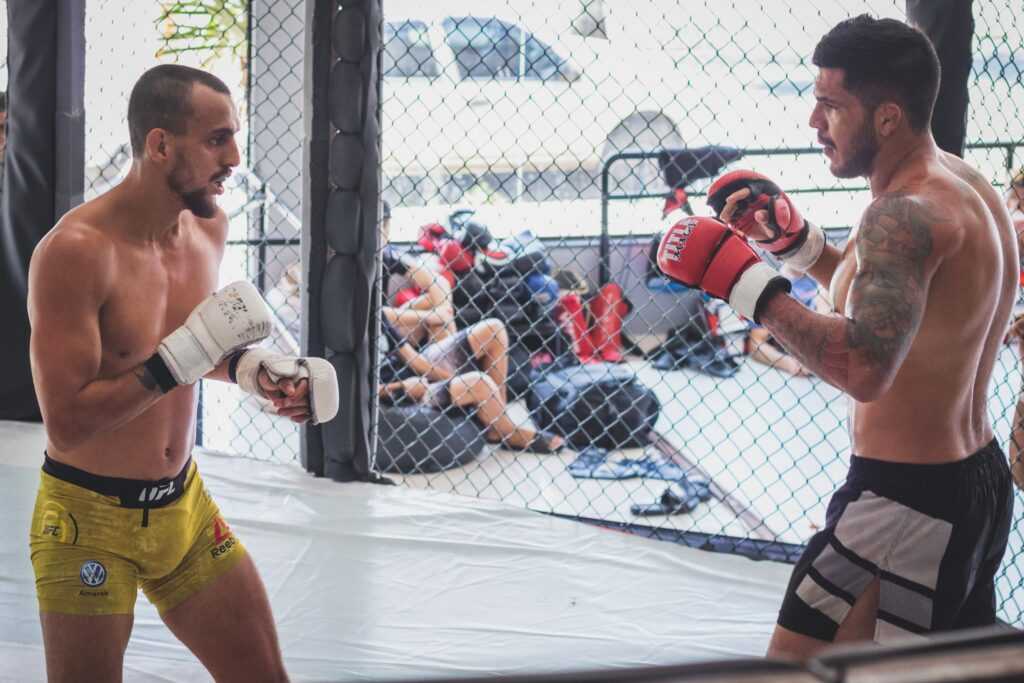
A heavy lift makes an effective training clip. It shows a clear task, an obvious load and a result viewers can understand immediately. An MMA training camp is harder to judge. The athlete must prepare for an opponent who changes distance, interrupts plans and creates situations that cannot be reduced to a single gym test.
That is why preparation deserves a broader explanation than getting stronger. Skill practice, conditioning, nutrition and recovery all belong in the discussion, but their presence does not give an outside observer complete knowledge of a fighter’s readiness. For fans assessing MMA predictions, the challenge is to use the evidence available without inventing the evidence that is missing.
Begin with the demands of the matchup
The right analytical starting point is the task the athlete expects to face. A contest likely to involve repeated grappling exchanges raises different questions from one expected to feature long periods of distance striking. A general statement that someone trained hard does not explain how that work addressed the opponent.
In research comparing official and simulated MMA matches, investigators observed high-intensity metabolic demands. That finding supports viewing the sport as a demanding combination of actions rather than as a strength demonstration. It does not identify the ideal training program for every athlete.
When reading camp coverage, look for specific, attributable information about preparation. A documented coaching change or a fighter’s clear explanation of a tactical priority may help frame the matchup. A motivational caption is much weaker evidence of a meaningful change.
Nutrition supports the work rather than replacing it
The joint Nutrition and Athletic Performance position paper from the Academy of Nutrition and Dietetics, Dietitians of Canada and the American College of Sports Medicine treats food and fluid strategies as relevant to athletic performance and recovery. It also recommends individualized guidance from qualified nutrition professionals.
For an outside analyst, the important implication is not that one menu predicts a winner. It is that nutrition should be understood in relation to training, competition and the individual athlete. A meal photograph does not reveal an entire intake pattern, and a sponsor’s product does not establish what caused a later result.
Consider a fictional fighter who posts a carefully prepared dinner after training. The photograph may tell you what was served at that moment. It does not establish daily intake, adherence across camp or whether the approach suits the athlete. Treating it as a major predictive signal would require evidence the image does not contain.
More visible effort is not automatically better preparation
A highlight reel usually selects moments that look difficult. That creates an obvious analytical limitation: viewers do not see the complete balance of technical sessions, physical work and time away from demanding activity. A harder-looking clip is not a reliable ranking of two camps.
The useful question is whether public evidence shows a relevant skill being applied more effectively in competition. Has the athlete demonstrated a better response to a recurring problem? Does recent footage of actual bouts support the claimed adjustment?
This does not make training information worthless. It changes its status. A camp statement can generate a hypothesis, while competitive performance provides an opportunity to test it. Keep those two stages separate when explaining why your view of a fighter has changed.
Weight-making claims need particular care
A fighter’s appearance near a weigh-in invites dramatic interpretation, but photographs cannot quantify hydration, medical status or subsequent recovery. Avoid presenting a drawn face as a diagnosis or a confident smile as evidence that the process was easy.
A small study of rapid weight loss in MMA athletes reported adverse biochemical and hormonal responses. That is a reason to take the subject seriously, not a basis for copying a fighter’s methods or estimating a specific opponent’s condition from appearance.
This article is a guide to interpreting public information, not a weight-cutting or nutrition plan. Decisions about an athlete’s diet, hydration and readiness belong with appropriately qualified professionals who can assess that athlete directly.
Organize camp information by evidence quality
A practical research note can separate confirmed facts, attributed claims and unknowns. Confirmed facts might include an official opponent change or the scheduled number of rounds. An attributed claim might be the fighter’s statement that a new coach has changed the game plan. Unknowns include private health information and unreported training interruptions.
This structure helps prevent a common error: counting a public claim as an established performance improvement. A new facility may be real; its effect on the next fight still needs evaluation. A longer camp may be documented; the quality of that camp remains a separate question.
When reading AgentMMA’s UFC predictions and matchup previews, apply the same distinction. Compare the proposed route to victory with what is publicly established about the matchup, rather than allowing a preparation narrative to substitute for technical analysis.
Ask what preparation should make observable
A useful camp claim points toward something the viewer can later examine. An athlete working on defensive wrestling might show a different response to entries. Someone emphasizing pacing might make different choices after an early exchange. These are examples of testable expectations, not promises that any particular change will succeed.
The strongest preparation analysis therefore ends with a question rather than a slogan. What problem was the camp meant to solve, what evidence suggests progress and what resistance will the opponent provide? That approach respects the importance of nutrition and conditioning without pretending that spectators can audit a private training camp from a few public posts.
 Evelyna Fenskerton has opinions about wellness and lifestyle insights. Informed ones, backed by real experience — but opinions nonetheless, and they doesn't try to disguise them as neutral observation. They thinks a lot of what gets written about Wellness and Lifestyle Insights, Expert Nutritional Guidance, Dietary Supplements Review is either too cautious to be useful or too confident to be credible, and they's work tends to sit deliberately in the space between those two failure modes.